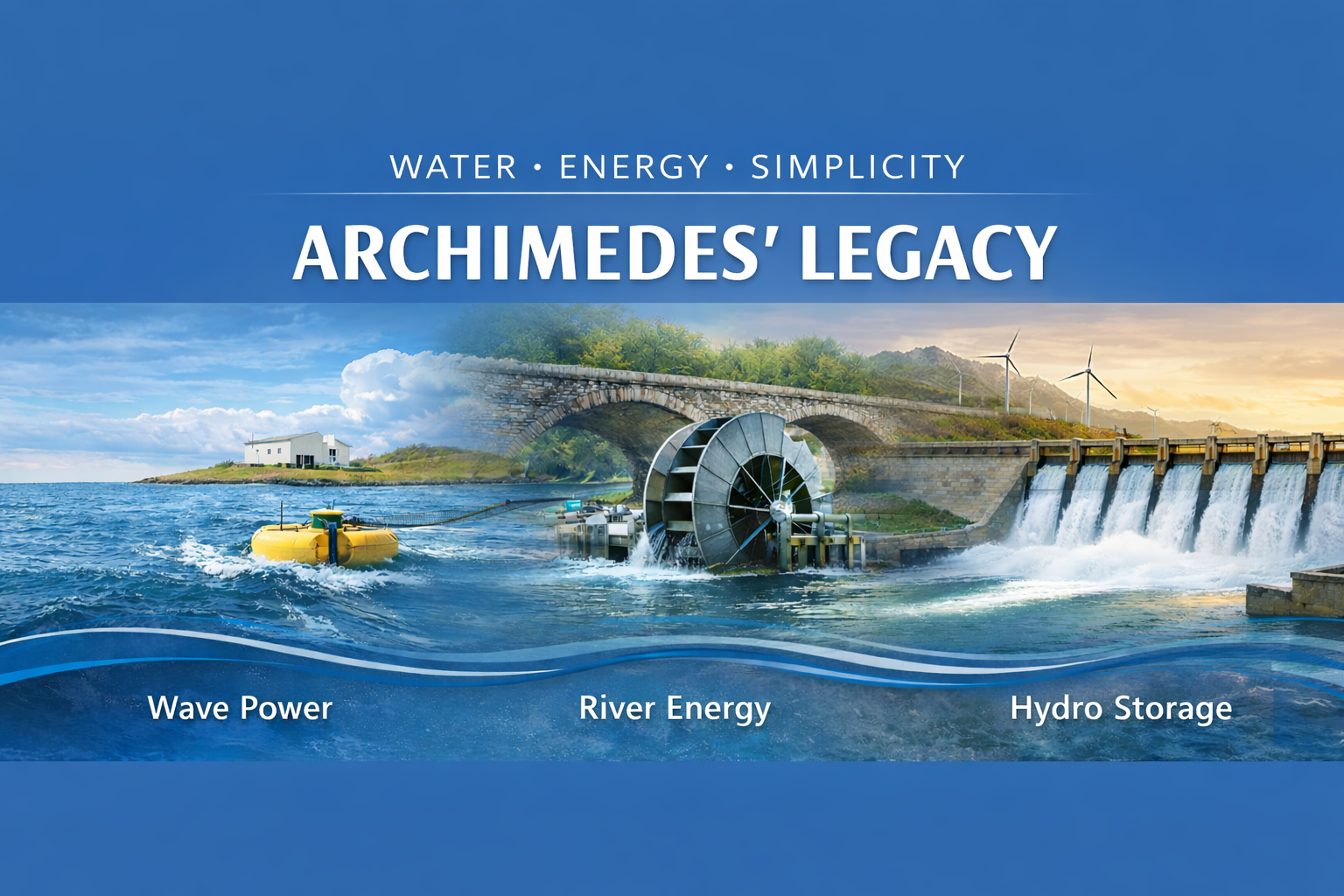
A modular wave-to-hydro storage system that converts ocean motion into stored water and grid-stable electricity using proven hydropower technology—reducing offshore risk while enabling scalable blue energy deployment.
Despite Europe’s vast coastline, wave energy remains commercially marginal due to corrosion, offshore maintenance costs, and unstable power output.
Most technologies attempt direct offshore electricity generation, exposing sensitive systems to harsh marine environments—raising CAPEX, OPEX, and investor risk.
Archimedes’ Legacy separates capture and generation: waves mechanically pump water offshore, which is then routed to onshore hydropower turbines.
This approach enhances durability, lowers lifecycle cost, improves bankability, and supports EU goals in energy independence, decarbonisation, and Blue Economy industrial growth.
See more information about this level and the TRL and SRL levels.
The BRIGAID Business Development Programme has been successfully completed. A MAF+ assessment has been conducted and its results have been enriched and incorporated into a business plan document.
The system’s main components have been individually tested, and an initial integration has been completed.
Archimedes’ Legacy is a two-phase wave energy system that separates energy capture from electricity generation. Offshore, ocean waves drive a mechanical pumping system that lifts seawater to an elevated onshore reservoir. Onshore, the stored water is released through conventional hydropower turbines to generate grid-stable electricity.
Unlike most wave technologies, this system avoids placing sensitive electrical equipment in harsh marine environments. By combining simple offshore mechanics with mature hydropower generation, the system improves durability, reduces maintenance risk, and enables integrated energy storage.
The result is a modular, scalable solution for coastal and island regions seeking predictable renewable energy, water storage, and improved grid stability.
The system operates in two coordinated phases:
Phase 1 – Mechanical Wave Pumping (Offshore):
Wave motion activates a robust mechanical structure (e.g., oscillating arms, piston systems, or float-driven linkages) designed to convert vertical wave movement into pressurized water flow. Instead of generating electricity offshore, the system pumps seawater through a pipeline toward land or an elevated coastal reservoir.
Phase 2 – Hydropower Generation (Onshore):
The pumped water is stored temporarily and then released through conventional hydro turbines. Electricity generation occurs onshore, using mature, grid-compatible hydropower equipment. This enables dispatchable output and simplified maintenance access.
The innovation lies in the architectural separation of capture and generation. By avoiding offshore electrical systems, corrosion-sensitive components, and subsea turbines, the design reduces lifecycle risk and improves bankability.
Development so far includes conceptual engineering design, system architecture validation, technical publications, and international innovation recognition. The next stage involves pilot-scale mechanical prototyping and coastal demonstration in collaboration with marine engineering and energy partners.
The system performs best in coastal areas with consistent wave energy and accessible elevation for water storage.
It is less effective in low-wave-energy regions or flat coastlines where reservoir elevation is minimal.
Site-specific marine engineering, environmental permitting, and grid interconnection studies are required before deployment.
A modular wave-to-hydro storage system that converts ocean motion into stored water and grid-stable electricity using proven hydropower technology—reducing offshore risk while enabling scalable blue energy deployment.
Despite Europe’s vast coastline, wave energy remains commercially marginal due to corrosion, offshore maintenance costs, and unstable power output.
Most technologies attempt direct offshore electricity generation, exposing sensitive systems to harsh marine environments—raising CAPEX, OPEX, and investor risk.
Archimedes’ Legacy separates capture and generation: waves mechanically pump water offshore, which is then routed to onshore hydropower turbines.
This approach enhances durability, lowers lifecycle cost, improves bankability, and supports EU goals in energy independence, decarbonisation, and Blue Economy industrial growth.
The BRIGAID Business Development Programme has been successfully completed. A MAF+ assessment has been conducted and its results have been enriched and incorporated into a business plan document.
The main components of the system have been tested separately, and an initial integration exercise has been conducted.
Archimedes’ Legacy is a two-phase wave energy system that separates energy capture from electricity generation. Offshore, ocean waves drive a mechanical pumping system that lifts seawater to an elevated onshore reservoir. Onshore, the stored water is released through conventional hydropower turbines to generate grid-stable electricity.
Unlike most wave technologies, this system avoids placing sensitive electrical equipment in harsh marine environments. By combining simple offshore mechanics with mature hydropower generation, the system improves durability, reduces maintenance risk, and enables integrated energy storage.
The result is a modular, scalable solution for coastal and island regions seeking predictable renewable energy, water storage, and improved grid stability.
The system operates in two coordinated phases:
Phase 1 – Mechanical Wave Pumping (Offshore):
Wave motion activates a robust mechanical structure (e.g., oscillating arms, piston systems, or float-driven linkages) designed to convert vertical wave movement into pressurized water flow. Instead of generating electricity offshore, the system pumps seawater through a pipeline toward land or an elevated coastal reservoir.
Phase 2 – Hydropower Generation (Onshore):
The pumped water is stored temporarily and then released through conventional hydro turbines. Electricity generation occurs onshore, using mature, grid-compatible hydropower equipment. This enables dispatchable output and simplified maintenance access.
The innovation lies in the architectural separation of capture and generation. By avoiding offshore electrical systems, corrosion-sensitive components, and subsea turbines, the design reduces lifecycle risk and improves bankability.
Development so far includes conceptual engineering design, system architecture validation, technical publications, and international innovation recognition. The next stage involves pilot-scale mechanical prototyping and coastal demonstration in collaboration with marine engineering and energy partners.
Not a member yet?
No worries, you can register here.
Name field No Space Allowed.
Already a member? login here
Not a member yet?
No worries, you can register here.
You know what they say, sharing is caring! You can share this innovation with as many people you feel will be interested in it.
Tip: include a message about why it caught your eye.
Did something peak your interest? You can share any questions, praises, comments, or concerns and the company will recieve them directly. No need for middle-men here.
Lorem ipsum dolor sit amet, consectetur adipiscing elit. Ut elit tellus, luctus nec ullamcorper mattis, pulvinar dapibus leo.