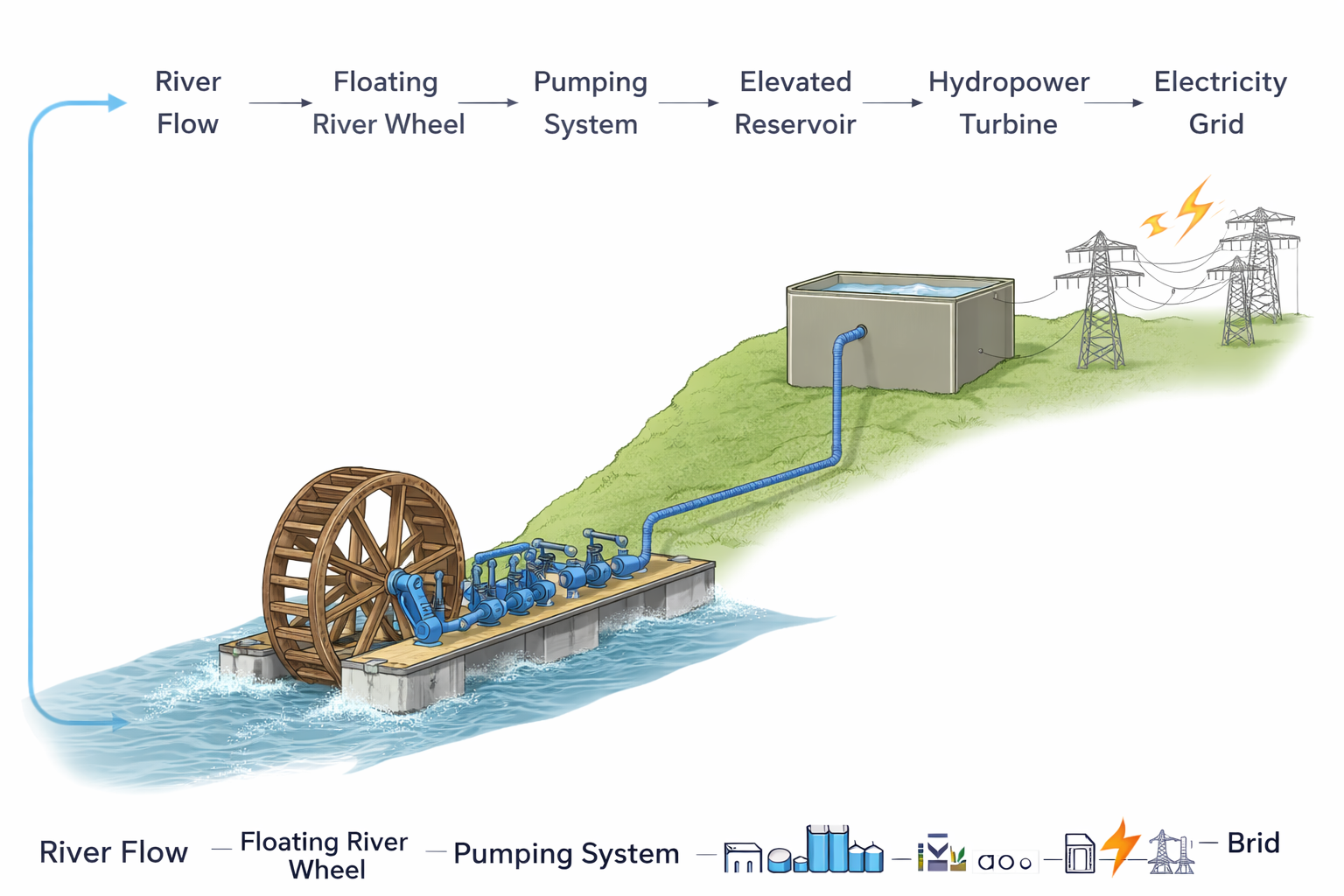
Floating river wheels drive mechanical pumps that lift water to small reservoirs, then generate electricity through micro-hydropower. A modular, low-impact system that converts natural river flow into scalable clean energy.
Many river-rich regions lack access to reliable electricity but large hydropower dams are expensive, environmentally disruptive, and often socially controversial. At the same time, vast kinetic energy from natural river currents remains largely unused.
The River-Phase Hydro Pump Framework transforms this underutilized resource into practical clean energy. Floating river wheels convert river flow into mechanical pumping power that lifts water to a modest reservoir. The stored water is then released through conventional hydropower turbines to produce stable electricity.
This approach avoids the need for large dams while enabling modular, low-impact energy generation suitable for rural communities, developing economies, and climate-vulnerable regions.
See more information about this level and the TRL and SRL levels.
The BRIGAID Business Development Programme has been successfully completed. A MAF+ assessment has been conducted and its results have been enriched and incorporated into a business plan document.
The system’s main components have been individually tested, and an initial integration has been completed.
The River-Phase Hydro Pump Framework converts natural river current into grid-compatible electricity using simple mechanical systems. Floating water wheels capture kinetic energy from flowing rivers and convert it into rotational motion.
This mechanical power drives piston pumps that lift water to a modest elevated reservoir. The stored water is then released through a conventional hydropower turbine to generate stable electricity.
By separating energy capture (river current) from electricity generation (hydropower turbine), the system avoids the need for large dams or complex underwater electrical equipment.
The framework is modular and scalable: multiple floating units can be deployed along wide rivers, forming distributed renewable energy systems. In addition to electricity generation, the pumped water can also support irrigation, aquaculture, or industrial use, creating a dual-output energy and water solution.
The River-Phase Hydro Pump Framework is designed as a three-stage energy conversion system that transforms river current into stable hydropower generation.
Stage 1 – River Phase: Mechanical energy capture
Floating water wheels installed on a multi-ferry platform intercept river current and convert kinetic energy into rotational motion. The wheels operate at low speed and high torque, allowing reliable performance even in debris-laden rivers.
Stage 2 – Pumping Phase: Hydraulic energy transfer
The rotational motion drives multiple piston pumps mounted on the floating platform. These pumps lift water to a modest elevated reservoir. In this stage, water itself becomes the energy carrier, transferring mechanical energy safely from the river to a controlled onshore system.
Stage 3 – Hydropower Phase: Electricity generation
The stored water is released through a conventional turbine-generator set. Because the turbine operates under controlled hydraulic conditions, the system can produce stable electricity suitable for grid integration.
A typical reference configuration described in the framework includes a floating platform with multiple water wheels, piston pumps, and a compact reservoir providing short-term hydraulic buffering. The design is modular: individual units can deliver tens of kilowatts of power and can be replicated along river corridors to reach megawatt-scale capacity.
Unlike conventional hydropower plants, the system avoids large dams, deep reservoirs, and major civil works. The framework relies on simple mechanical components—wheels, shafts, and pumps—that can be locally manufactured and maintained.
This approach enables distributed renewable energy generation in river-rich regions while minimizing environmental disruption.
The River-Phase Hydro Pump Framework depends on the availability of continuous river flow. Very slow rivers with low current velocity may produce insufficient mechanical power to operate the system effectively.
Seasonal variations in river flow can also affect energy output. While the reservoir provides short-term buffering, prolonged low-flow conditions may reduce generation capacity.
The system also requires suitable river width and navigation clearance to install floating platforms without obstructing river transport.
These limitations can be mitigated through careful site selection, modular deployment across multiple river sections, and integration with other renewable energy sources.
Floating river wheels drive mechanical pumps that lift water to small reservoirs, then generate electricity through micro-hydropower. A modular, low-impact system that converts natural river flow into scalable clean energy.
Many river-rich regions lack access to reliable electricity but large hydropower dams are expensive, environmentally disruptive, and often socially controversial. At the same time, vast kinetic energy from natural river currents remains largely unused.
The River-Phase Hydro Pump Framework transforms this underutilized resource into practical clean energy. Floating river wheels convert river flow into mechanical pumping power that lifts water to a modest reservoir. The stored water is then released through conventional hydropower turbines to produce stable electricity.
This approach avoids the need for large dams while enabling modular, low-impact energy generation suitable for rural communities, developing economies, and climate-vulnerable regions.
The BRIGAID Business Development Programme has been successfully completed. A MAF+ assessment has been conducted and its results have been enriched and incorporated into a business plan document.
The main components of the system have been tested separately, and an initial integration exercise has been conducted.
The River-Phase Hydro Pump Framework converts natural river current into grid-compatible electricity using simple mechanical systems. Floating water wheels capture kinetic energy from flowing rivers and convert it into rotational motion.
This mechanical power drives piston pumps that lift water to a modest elevated reservoir. The stored water is then released through a conventional hydropower turbine to generate stable electricity.
By separating energy capture (river current) from electricity generation (hydropower turbine), the system avoids the need for large dams or complex underwater electrical equipment.
The framework is modular and scalable: multiple floating units can be deployed along wide rivers, forming distributed renewable energy systems. In addition to electricity generation, the pumped water can also support irrigation, aquaculture, or industrial use, creating a dual-output energy and water solution.
The River-Phase Hydro Pump Framework is designed as a three-stage energy conversion system that transforms river current into stable hydropower generation.
Stage 1 – River Phase: Mechanical energy capture
Floating water wheels installed on a multi-ferry platform intercept river current and convert kinetic energy into rotational motion. The wheels operate at low speed and high torque, allowing reliable performance even in debris-laden rivers.
Stage 2 – Pumping Phase: Hydraulic energy transfer
The rotational motion drives multiple piston pumps mounted on the floating platform. These pumps lift water to a modest elevated reservoir. In this stage, water itself becomes the energy carrier, transferring mechanical energy safely from the river to a controlled onshore system.
Stage 3 – Hydropower Phase: Electricity generation
The stored water is released through a conventional turbine-generator set. Because the turbine operates under controlled hydraulic conditions, the system can produce stable electricity suitable for grid integration.
A typical reference configuration described in the framework includes a floating platform with multiple water wheels, piston pumps, and a compact reservoir providing short-term hydraulic buffering. The design is modular: individual units can deliver tens of kilowatts of power and can be replicated along river corridors to reach megawatt-scale capacity.
Unlike conventional hydropower plants, the system avoids large dams, deep reservoirs, and major civil works. The framework relies on simple mechanical components—wheels, shafts, and pumps—that can be locally manufactured and maintained.
This approach enables distributed renewable energy generation in river-rich regions while minimizing environmental disruption.
Not a member yet?
No worries, you can register here.
Name field No Space Allowed.
Already a member? login here
Not a member yet?
No worries, you can register here.
You know what they say, sharing is caring! You can share this innovation with as many people you feel will be interested in it.
Tip: include a message about why it caught your eye.
Did something peak your interest? You can share any questions, praises, comments, or concerns and the company will recieve them directly. No need for middle-men here.
Lorem ipsum dolor sit amet, consectetur adipiscing elit. Ut elit tellus, luctus nec ullamcorper mattis, pulvinar dapibus leo.