Issues
New Issues
Areas
Areas
Solutions
Solutions
TRL Level
TRL Level
SRL Level
SRL Level
Floating river wheels drive mechanical pumps that lift water to small reservoirs, then generate electricity through micro-hydropower. A modular, low-impact system that...

River-Phase Hydro Pump Framework: Reimagining Historic River Wheels for Modern Hydropower

Floating river wheels drive mechanical pumps that lift water to small reservoirs, then generate electricity through micro-hydropower. A modular, low-impact system that converts natural river flow into scalable clean energy.

1. Low-impact river energy- Generates clean electricity without large dams or major river ecosystem disruption.
2. Modular and scalable- Floating river wheels and pump units can be deployed gradually across many river sites.
3. Affordable local manufacturing- Uses simple mechanical systems that can be built and maintained with local skills and materials.

Many river-rich regions lack access to reliable electricity but large hydropower dams are expensive, environmentally disruptive, and often socially controversial. At the same time, vast kinetic energy from natural river currents remains largely unused.

The River-Phase Hydro Pump Framework transforms this underutilized resource into practical clean energy. Floating river wheels convert river flow into mechanical pumping power that lifts water to a modest reservoir. The stored water is then released through conventional hydropower turbines to produce stable electricity.

This approach avoids the need for large dams while enabling modular, low-impact energy generation suitable for rural communities, developing economies, and climate-vulnerable regions.


2025 - AltEnergyMag Press Releases:
2025 - eBook "Historic River Wheels Reimagined for Modern Hydropower" Published
TRL3. Critical function: Proof of concept established
The River-Phase Hydro Pump Framework is currently at TRL 3, where the core concept and operating principles have been analytically developed and documented. The system architecture—including floating river-wheel platforms, piston pump mechanisms, hydraulic head calculations, and hydropower integration—has been defined through engineering analysis and conceptual design work. A reference configuration delivering approximately 50 kW electrical output has been developed to demonstrate practical feasibility. The concept builds upon historically proven river-wheel technologies and integrates them with modern hydropower systems using a structured three-phase energy conversion framework (river current capture, mechanical pumping, and turbine generation). The innovation has been documented in technical publications and an engineering concept eBook, providing detailed system architecture, operational logic, and scaling potential. However, physical prototyping and field validation have not yet been completed, which places the technology at the experimental proof-of-concept stage.
SRL3
The concept has begun reaching stakeholders through international publications, clean-energy media coverage, and online innovation platforms. Early awareness has been created among engineers, researchers, and climate innovation communities. The framework specifically targets river-rich regions where energy access, irrigation demand, and climate resilience are important challenges. Because the system uses simple mechanical components and floating deployment, it is designed to be locally manufacturable and socially adaptable in developing regions. At this stage, stakeholder engagement has primarily taken the form of knowledge sharing, concept dissemination, and exploratory discussions with energy innovation communities. Community-level pilot projects and formal institutional partnerships have not yet been established. Therefore, the innovation is currently positioned at SRL 3, representing early awareness and initial exploration of potential social adoption.

See more information about this level and the TRL and SRL levels.

Business plan completed

The BRIGAID Business Development Programme has been successfully completed. A MAF+ assessment has been conducted and its results have been enriched and incorporated into a business plan document.

The system’s main components have been individually tested, and an initial integration has been completed.

Credits
CREDITS
Executive Engineer (Power Grid Bangladesh), Founder of Archimedes’ Legacy, Clean Energy System Designer - Md. Moniruzzaman
Collaborators
COLLABORATORS
Open to academic and engineering collaboration for prototype testing and deployment.

How does it work?

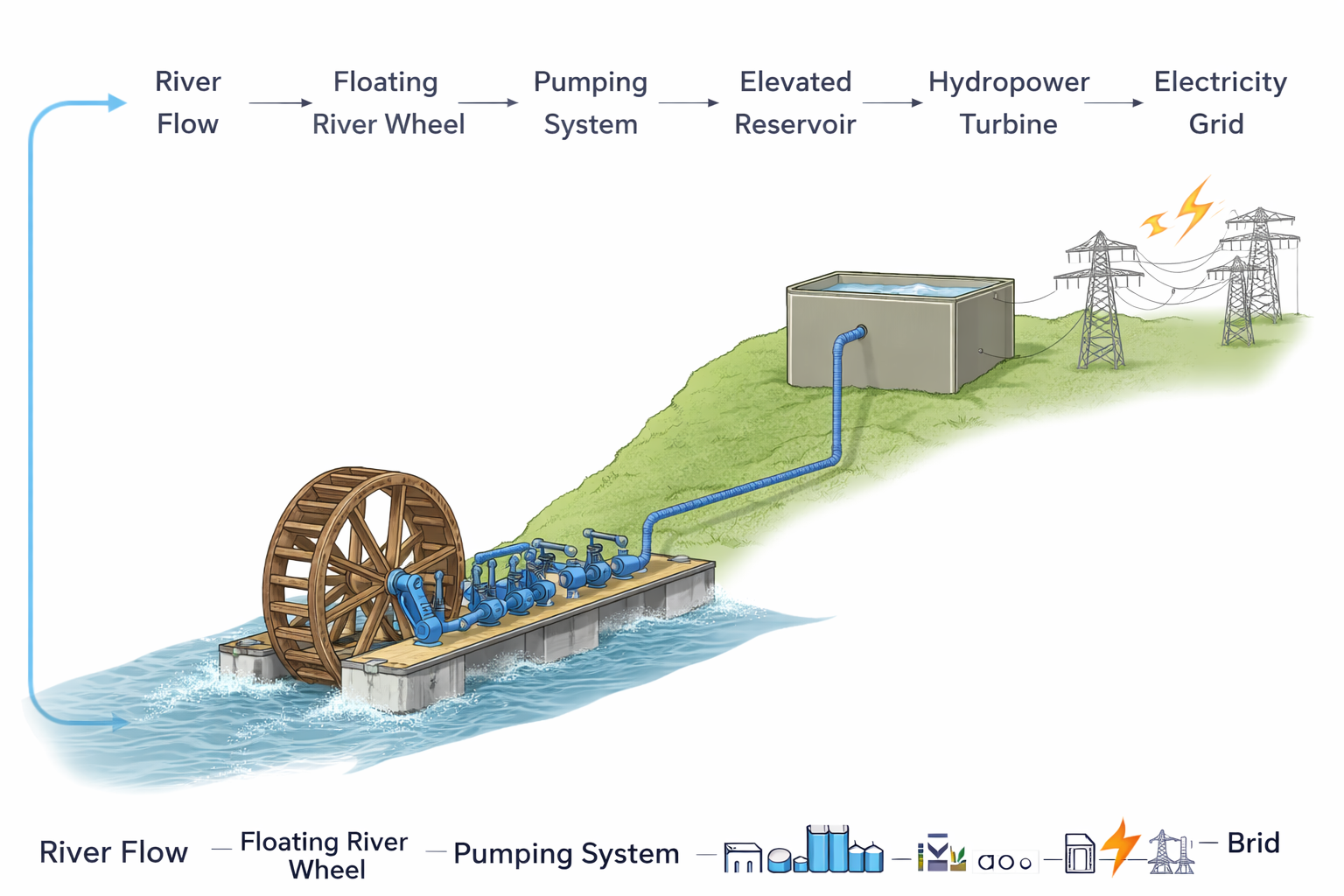
The River-Phase Hydro Pump Framework converts natural river current into grid-compatible electricity using simple mechanical systems. Floating water wheels capture kinetic energy from flowing rivers and convert it into rotational motion.

This mechanical power drives piston pumps that lift water to a modest elevated reservoir. The stored water is then released through a conventional hydropower turbine to generate stable electricity.

By separating energy capture (river current) from electricity generation (hydropower turbine), the system avoids the need for large dams or complex underwater electrical equipment.

The framework is modular and scalable: multiple floating units can be deployed along wide rivers, forming distributed renewable energy systems. In addition to electricity generation, the pumped water can also support irrigation, aquaculture, or industrial use, creating a dual-output energy and water solution.

The River-Phase Hydro Pump Framework is designed as a three-stage energy conversion system that transforms river current into stable hydropower generation.

Stage 1 – River Phase: Mechanical energy capture
Floating water wheels installed on a multi-ferry platform intercept river current and convert kinetic energy into rotational motion. The wheels operate at low speed and high torque, allowing reliable performance even in debris-laden rivers.

Stage 2 – Pumping Phase: Hydraulic energy transfer
The rotational motion drives multiple piston pumps mounted on the floating platform. These pumps lift water to a modest elevated reservoir. In this stage, water itself becomes the energy carrier, transferring mechanical energy safely from the river to a controlled onshore system.

Stage 3 – Hydropower Phase: Electricity generation
The stored water is released through a conventional turbine-generator set. Because the turbine operates under controlled hydraulic conditions, the system can produce stable electricity suitable for grid integration.

A typical reference configuration described in the framework includes a floating platform with multiple water wheels, piston pumps, and a compact reservoir providing short-term hydraulic buffering. The design is modular: individual units can deliver tens of kilowatts of power and can be replicated along river corridors to reach megawatt-scale capacity.

Unlike conventional hydropower plants, the system avoids large dams, deep reservoirs, and major civil works. The framework relies on simple mechanical components—wheels, shafts, and pumps—that can be locally manufactured and maintained.

This approach enables distributed renewable energy generation in river-rich regions while minimizing environmental disruption.

The River-Phase Hydro Pump Framework depends on the availability of continuous river flow. Very slow rivers with low current velocity may produce insufficient mechanical power to operate the system effectively.

Seasonal variations in river flow can also affect energy output. While the reservoir provides short-term buffering, prolonged low-flow conditions may reduce generation capacity.

The system also requires suitable river width and navigation clearance to install floating platforms without obstructing river transport.

These limitations can be mitigated through careful site selection, modular deployment across multiple river sections, and integration with other renewable energy sources.

Oh! You need to log in to access this information.
Not a member yet? No worries, you can register here.

Other

innovations

Other Archimedes' Legacy innovations
Floating river wheels drive mechanical pumps that lift water to small reservoirs, then generate electricity through micro-hydropower. A modular, low-impact system that...
A modular wave-to-hydro storage system that converts ocean motion into stored water and grid-stable electricity using proven hydropower technology—reducing offshore ri...

Related posts

Floating river wheels drive mechanical pumps that lift water to small reservoirs, then generate electricity through micro-hydropower. A modular, low-impact system that...
A modular wave-to-hydro storage system that converts ocean motion into stored water and grid-stable electricity using proven hydropower technology—reducing offshore ri...
An IoT-based environmental monitoring platform. It manages climate risks using real-time air, climate, and water data. Strong ESG relevance, public-sector integration,...

Want to explore
some more?

Head on over to our ?
page to find other materials organized by different categories.

Welcome back!

Log in to stay connected with your
favorite innovators

Not a member yet?
No worries, you can register here.

Create account

Enter some personal details
and you’re good to go!

Name field No Space Allowed.
Already a member? login here

Name *
E-mail *
Password *
Confirm Password *

Welcome back!

Log in to stay connected with your
favorite innovators

Not a member yet?
No worries, you can register here.

Create account

Enter some personal details
and you’re good to go!

Name *
E-mail *
Password *
Confirm Password *

Already a member? Login here

Share this

Md. Moniruzzaman

innovation

You know what they say, sharing is caring! You can share this innovation with as many people you feel will be interested in it.
Tip: include a message about why it caught your eye.

Responsible: ASOCIACIÓN BRIGAID CONNECT.

Purpose and legitimacy: attention and management of the consultation made by the USER who completes the Personal Data of the Contact Form. If the USER gives his/her consent, the contact data will be used to send him/her commercial information.

Rights: Access, rectification, opposition, deletion, portability, limitation of processing, not to be subject to automated decisions, as indicated in the additional information.

Transfer: If the USER gives express consent, the data may be transferred to entities related to ASOCIACIÓN BRIGAID CONNECT or belonging to the ASOCIACIÓN BRIGAID CONNECT GROUP. It will not be necessary to obtain your consent when the transfer is covered by the legitimate interest of the Responsible for the Web.

Additional information: You can consult additional and detailed information on Data Protection in our Privacy Policy.

Connect with

Md. Moniruzzaman

Did something peak your interest? You can share any questions, praises, comments, or concerns and the company will recieve them directly. No need for middle-men here.

Responsible: ASOCIACIÓN BRIGAID CONNECT.

Purpose and legitimacy: attention and management of the consultation made by the USER who completes the Personal Data of the Contact Form. If the USER gives his/her consent, the contact data will be used to send him/her commercial information.

Rights: Access, rectification, opposition, deletion, portability, limitation of processing, not to be subject to automated decisions, as indicated in the additional information.

Transfer: If the USER gives express consent, the data may be transferred to entities related to ASOCIACIÓN BRIGAID CONNECT or belonging to the ASOCIACIÓN BRIGAID CONNECT GROUP. It will not be necessary to obtain your consent when the transfer is covered by the legitimate interest of the Responsible for the Web.

Additional information: You can consult additional and detailed information on Data Protection in our Privacy Policy.

Lorem ipsum dolor sit amet, consectetur adipiscing elit. Ut elit tellus, luctus nec ullamcorper mattis, pulvinar dapibus leo.

Filter

Issues
Issues
Areas
Areas
Solutions
Solutions
TRL Level
TRL Level
SRL Level
SRL Level